


“Inconceivable!”
It’s the word Vizzini keeps shouting in The Princess Bride, a cult classic and one of my favorite movies. He’s the scheming little kidnapper who reaches for it every time the world does something he has just declared impossible.
Here’s the scene I keep coming back to. Vizzini has kidnapped princess Buttercup and is sailing hard across the sea when a ship appears behind him captained by a man in black. He keeps thinking he is about to shake the follower, and he keeps being wrong. They reach the Cliffs of Insanity, scramble up a rope, and cut it loose behind them so no one can follow. Yet the man in black simply keeps climbing the sheer rock with his bare hands, gaining with every pull, until each time Vizzini looks back the thing he swore couldn’t keep up is still there, closer if anything.
“Inconceivable!”
I think about that scene because it resembles where the leading AI labs seem to be standing right now. They are climbing as fast as money can buy, and the money is staggering. They keep cutting the rope behind them, restricting who can use their best models, lobbying for export controls. And every time they glance back, the man in black is not far behind.
Right now that man in black is open-source models, most of them coming out of China. What should worry the labs is not the flag he climbs under but that he climbs for free, and that he can stay in the chase at all. Who he is, and how he can afford to keep climbing, is a question I am still chewing on. Vizzini was a fictional villain, and a fool besides. The companies making the same sound today are some of the smartest and best-funded on earth, and they have a serious story for why the climb is worth it. This is about why that story might be wrong.
The reasonable bet
The climbing is not just a metaphor, and it is not cheap. The four largest American technology companies spent something on the order of four hundred billion dollars on AI infrastructure last year, and have signaled they will spend close to seven hundred billion this year. One of them is Anthropic, the maker of the Claude models, and its chief executive, Dario Amodei, laid out the economics in a long interview with the podcaster Dwarkesh Patel. Anthropic spends most of what it raises training each new model. Taken on its own, Amodei says, each one turns a healthy profit. He sketches the math: a model that cost about a billion dollars to train can bring in four billion the next year, against a billion or so to run. The company loses money anyway, and only for one reason. The moment a model starts paying off, Anthropic takes the proceeds and pours them, plus billions more, into the next one, which is larger and can cost ten times as much to build.
His bet is that this cannot go on forever, and that one day it will not have to. Eventually the climb tops out, the spending levels off, and a lab that has stopped pouring everything into the next model gets to sit back and collect on the one it already has. To explain why, Amodei uses cloud computing as an example. The enormous cost of running global data centers left cloud computing to a handful of giants. “There are three, maybe four players within cloud,” he says. “I think that’s the same for AI.” So in his mind, the game is straightforward: build the best model, and let the sheer cost of building it serve as the wall. Raise more than your rivals, build big, stay in front. For a closed race among well-funded labs, it is a reasonable bet, and it might even be right.
This is Vizzini’s move, made with a balance sheet. Having climbed higher than almost anyone can afford, you cut the rope behind you and let the cost of the drop keep everyone else on the ground. Three or four climbers reach the top, the frantic spending finally eases, and the survivors sit down to rest and collect. It is a confident bet, and like Vizzini’s it rests entirely on one thing being true: that no one is still on the rock behind you.
Someone is. Further down the cliff, gaining with every pull, the man in black keeps climbing. Anthropic can charge a premium today because Claude is plainly better than anything else you can run. But the day the climber below pulls level, that premium does not merely shrink. It vanishes, because no one pays for what they can get for free.
How close, really?
Since the beginning of 2026 the labs had a comforting answer. They had just hauled themselves onto a new ledge, and it was not obvious anyone else could follow them up to it. For most of their brief history these models were things you talked to: you asked, they answered. The leap of the previous year was agency. A model could now be handed a goal and left to chase it on its own, writing code, running it, reading the error it threw back, fixing that, and grinding through a long job one step at a time with no human in the loop. Anthropic’s Claude Opus 4.5, released in late November, was the model that made this work reliably, and the tool the company built around it, Claude Code, turned that into a big business. This was the new ledge, and it looked like it belonged to the frontier labs.
The open models did not seem close to reaching it. They could hold a conversation and write a function or two, but handed a long agentic task they lost the thread halfway through. The frontier labs held the valuable new ground, the long autonomous work, while the open models stayed down in chatland, handy but harmless. Vizzini was up on the ledge with the hard climb behind him, and the man in black was still far below, surely about to fall.
Then the answer arrived on a Saturday in the middle of June. A Chinese company called Z.ai released a new model named GLM-5.2 and, as the Chinese labs now routinely do, gave it away, free not just to use but to own: anyone could download the whole thing, run it on their own machines, and build on top of it without paying a cent. And this one held together across exactly the long agentic work that was supposed to belong to the labs. The man in black had pulled himself onto the ledge.
The researchers who live inside these tools all day, the ones who can tell a model that demos well from one that holds up across a long stretch of real work, started saying the same sentence about it: this one keeps up.
One of them is Nathan Lambert, who writes a closely followed newsletter about open models and, by his own admission, wants them to win. He did the arithmetic that matters. The agentic bar GLM-5.2 had just cleared was the one Opus 4.5 set back in November. By matching it in the middle of June, the open model had closed the distance to two hundred and four days. That is how far back the man in black was: seven months, not seven years.
If one comparison sounds like an anecdote, there is a picture. A research group called Artificial Analysis scores models on a single measure of capability and tracks it over time, plotting the best closed models and the best open ones on the same axes.
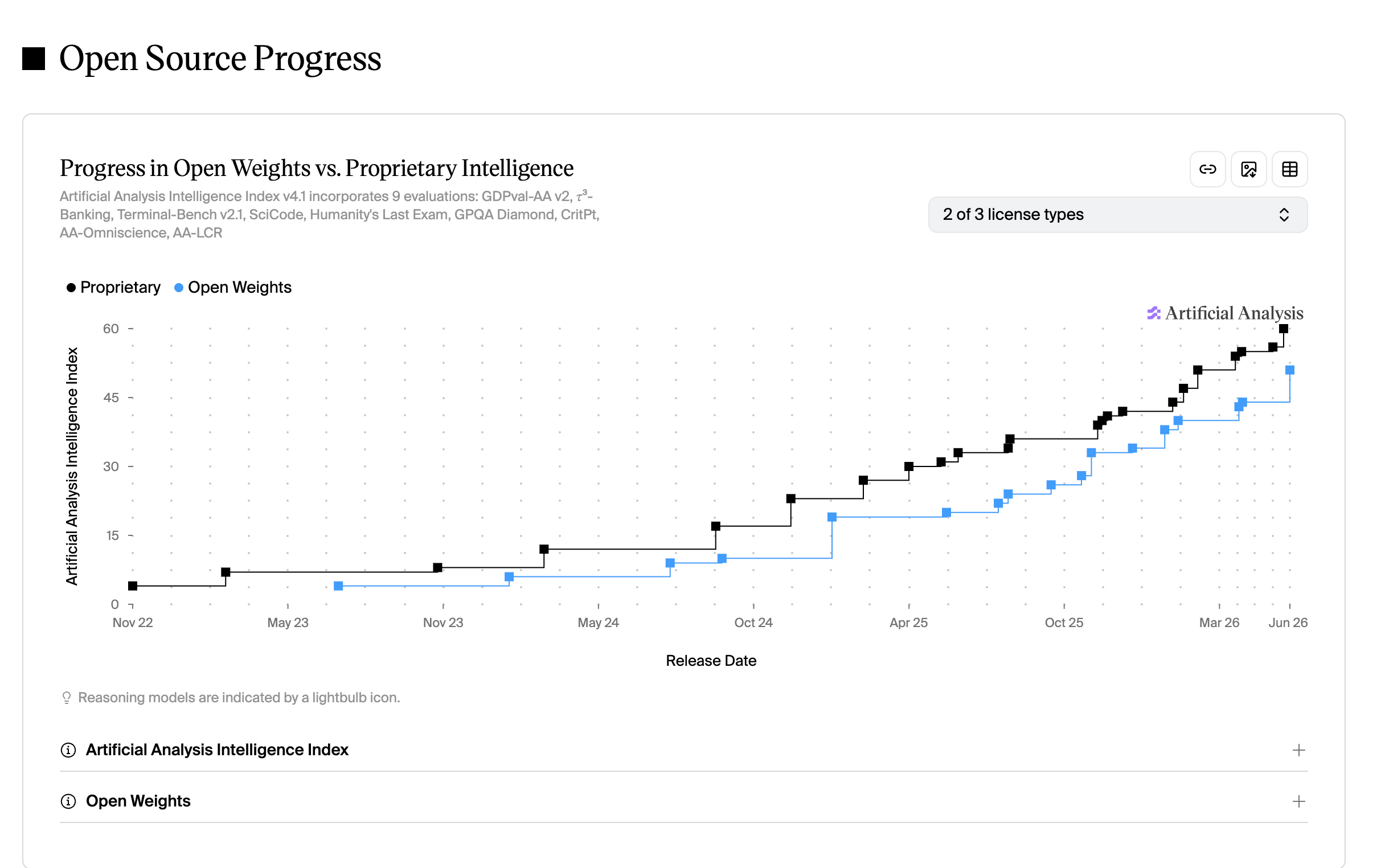
What surprised Lambert was not that the open models were close. It was that they were not falling behind. He had expected the gap to widen, because the American labs had spent the past year pouring in more computing power than ever, and more computing power is supposed to buy distance. “Upon writing this, I’m surprised,” he wrote. “As the U.S. labs have so rapidly ramped compute in the last year, I’ve expected the gap in performance to grow in time.” It hadn’t. Other people who track the gap put it even tighter, three or four months rather than seven, and none of them put it at years. The harder you look, the closer the climber turns out to be.
That is the shape the graph keeps drawing. Every time the frontier hauls itself up another step, the open line climbs the same step a few months behind, then settles in to do it again. Step, matched. Step, matched. And by some measures the delay is getting shorter, not longer. All that money, and it has bought no daylight.
This was not supposed to happen, and for a while it looked like it wouldn’t. Other climbers had tried to keep pace and give their work away, and they had dropped off the rock. Meta, the company behind Facebook and Instagram, poured money into its Llama models, the West’s great bet on open AI, and then lost its nerve, unwilling to keep handing the frontier away for nothing. One by one the challengers let go, and the labs looked down at a clearing cliff and decided the hard part was behind them.
But one of them keeps coming. Vizzini has cut every rope within reach, and the man in black is still there, hand over hand, past each obstacle meant to end him. The question is no longer whether he can be shaken loose. It is what makes him climb when all the others have let go, and whether anything can stop him at all. This is the climb I’ll explore in next week’s article.
For now, the labs have done everything their bet said would work, and he is still gaining. Watching him come, they are left with the one word Vizzini reached for every time the impossible refused to stop happening.
Inconceivable.
The next part of this series is now available: “No Rest at the Top”
Playing Different Games

At the beginning of the year, I was working on a project for a client. We needed to read documents and categorize them, but there was a catch—we didn't have the documents. We needed to find them first. The prevailing way to solve this with AI is to use an "agentic pattern." Instead of a linear workflow where humans…