


This is the second part of a series. In the first part, I told the race between open and closed AI models as one long chase from The Princess Bride: the big closed labs as Vizzini, scrambling up the cliffs and cutting the rope behind them, and the open models, most of them from China, as the man in black who keeps climbing no matter how much they spend to shake him. Start there if you missed it. This picks up at the top of the cliff.
At the top of the Cliffs of Insanity, the man in black finally catches Vizzini. Vizzini, certain he is the smartest man alive, sizes up his opponent and challenges him to a battle of wits.
The man in black sets the terms. Two cups of wine, one of them poisoned. Vizzini picks the cup, both men drink, and only one walks away. A simple game with no second chances.
Vizzini is delighted. This is his kind of contest. He distracts the man, secretly swaps the cups, and drinks, smug, certain he has taken the safe one. A moment later he falls over dead.
Both cups were poisoned. The choosing never mattered, and neither did the swap. The man in black had spent years taking small doses of the poison, a little more each time, until he could drink it and live. He did not out-think Vizzini. He rigged the game years before it started, by becoming a man who could survive the poison.
That is the part worth thinking about because it is how the man in black on the AI cliff keeps climbing. He is not matching the labs dollar for dollar. He is doing something they cannot, and he spent years learning how.
The man who never planned to eat
Remember the bet from the first piece. The labs pour every dollar into building the next model, betting the climb will one day end: the spending stops, three or four of them are left at the top, and they finally collect the fat margins the cloud giants enjoy today. Starve now, gorge later.
That bet assumes the man climbing behind them wants the same feast. But he never planned to eat. That is the one thing the labs cannot price against: not a rival who is smarter or better funded, but one who does not need the profit they need to survive.
None of this is new. Jeff Bezos said it plainly years ago: your margin is my opportunity. Amazon grew up in the retail industry (with razor thin margins), undercutting rivals whose comfortable markups were exactly the room it had to move in. The fat was the target. What a company treats as its reward for winning is the opening the follower climbs through. China took that same habit national, learning to operate where others would starve.
Ask Elon Musk
If you want to know what it feels like to be caught at the top of the cliff, ask Elon Musk.
Musk is our Vizzini. He carries himself as the most brilliant strategist in any room, and he has never been shy about saying so. In 2006, when Tesla had nothing to sell but a promise, he did the most Vizzini thing imaginable: he wrote his master plan down, posted it for the whole world to read, and called it, the Secret Master Plan.
The plan was three moves of pure swagger: build a fast, expensive car for the rich, use their money to build a cheaper one, then use that to build a car for everyone. And underneath it all sat the trick he was proudest of. The more batteries Tesla built, the cheaper batteries would get, until its costs fell so far that no rival could ever catch up. The moat was never the cars. It was the batteries. And he was certain the secret was his.
For a decade it worked exactly as written. The Roadster paid for the Model S, and the Model S paid for the Model 3. The batteries did just what he promised, getting cheaper year after year until a battery cost a small fraction of what it had when he started. Tesla rode the plan to the top of the world and became the first carmaker ever worth a trillion dollars. Musk had out-thought the entire industry, and for years the rest of us believed him, because the plan kept coming true. Like Vizzini in the second before he drinks, he was sure he had already won.
Then the man in black pulled onto the ledge, and here was the twist Musk never saw coming. The man who caught him was not a car company at all.
BYD was a battery company. It had been making batteries before Tesla existed, and only later built cars around them. So the moat Musk was counting on was not his clever secret. It was the other man’s whole life. Musk set out to build a car company with the best batteries in the world, and he was beaten by a battery company that decided to build cars. And a battery company forged in China’s manufacturing grind knew one more thing that never made it into the master plan: how to live on almost nothing.
The results came on schedule. BYD’s cheapest car, the Seagull, went on sale for around ten thousand dollars, a third of the price of Tesla’s cheapest. On the earnings call at the start of 2024, Musk admitted this aloud. The Chinese carmakers, he said, are “the most competitive car companies in the world,” and “if there are not trade barriers established, they will pretty much demolish most other companies in the world.” That is not a warning about the future. It is a man describing what was already climbing over him.
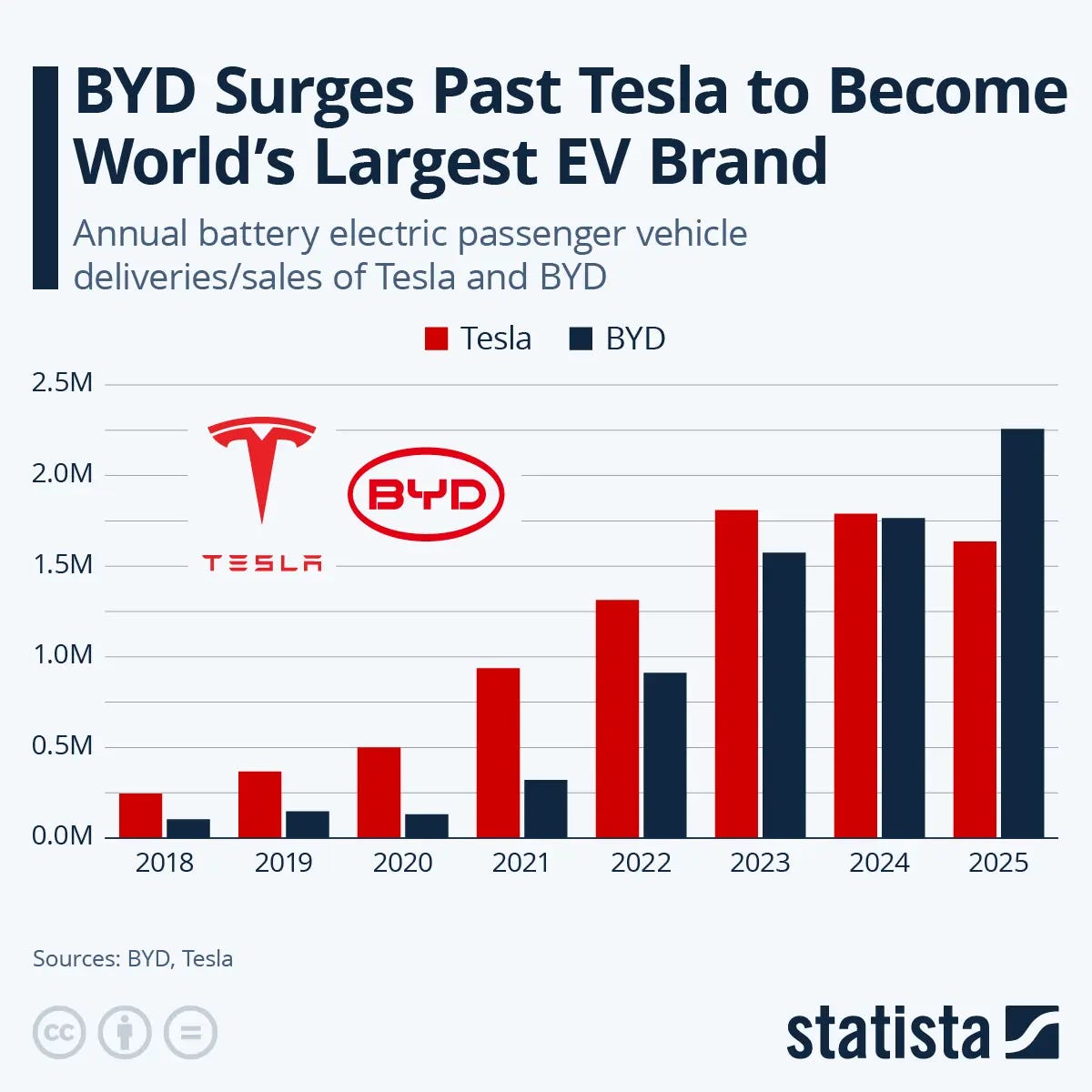
By 2025 the pass was clean. BYD sold more than two million electric cars, well ahead of Tesla, while Tesla’s sales fell for a second straight year and the fat profits it once enjoyed were cut roughly in half.
The only reason you do not see this on American roads is a wall. The United States put a one hundred percent tariff on Chinese electric cars, which keeps them out. President Trump has said why in plain terms: without it, “they would have destroyed General Motors, Ford.” Everywhere there is no such wall, the result is already in. In Southeast Asia, where there is little home-grown car industry to shield, Chinese brands make up the great majority of electric cars sold. In Europe, BYD has begun outselling Tesla outright.
And Tesla is the one still in good health. Volkswagen has moved to cut thirty-five thousand jobs, Stellantis watched its profit fall by seventy percent and pushed out its chief executive, and General Motors took a charge of more than five billion dollars on its shrinking China business. None of them was badly run. They were trying to breathe at a profit in a market where their pursuer was not, and behind that pursuer stood the state: by one careful count, more than two hundred billion dollars poured into Chinese electric cars over fifteen years.
This is what it looks like when the man in black reaches the top. He does not out-argue you. He drinks the poison you cannot, and you fall over.
The follower’s weapon
You might object that a car is a physical thing, stamped out of steel, and that software must play by different rules. It doesn’t, and the clearest proof is a move the software world has already watched work. The investor Bill Gurley has a name for it: open source is the weapon of the follower. When you cannot beat the leader head-on, you give your own product away, not out of generosity, but to turn the rest of the market into your army against him.
Google has run the play twice. In 2007 it watched Apple invent the modern smartphone and saw the danger at once: whoever owned the phone would own the doorway to search and advertising, which was to say Google’s entire business. Google could not build a better iPhone. So it built a phone operating system, Android, and gave it away to every handset maker willing to take on Apple. Overnight Apple was no longer fighting Google. It was fighting Samsung and the whole of the rest of the industry, every one of them standing on Google’s free foundation. Today Android runs most of the phones on earth, and each of them is still a doorway back to Google. It gave away the operating system and kept the gateway.
A few years later Google did the same to Amazon, handing the industry a free version of its own plumbing for running data centers, a system called Kubernetes, until even Amazon had to support it. The lesson each time is the one worth carrying into what follows: the follower does not out-build the leader. It gives the crowd a free way to build, and becomes the ground they all stand on.
While everyone watches the frontier
This is the move China is making in AI right now, and it is happening while everyone stares at the summit.
The American labs have trained us to keep our eyes fixed on the top of the cliff: which model is smartest this month, who topped which benchmark. Meanwhile, lower on the same cliff face, the Chinese labs have been giving their models away, and the world has begun building on them. Not in theory. In the products you may already use.
Cursor, the coding tool programmers love, quietly runs its own model on top of Kimi, from a lab in Beijing. Airbnb runs much of its customer service on Alibaba’s Qwen, a model its chief executive calls “very good, fast and cheap.” It reaches the frontier too: Harvey, the leading legal-AI company, took GLM from Z.ai, the same lab that set off the first half of this story, and turned it into a legal agent that beat the best models America sells, GPT-5.5 and Claude Opus, on its own tests. And none of this is a handful of anecdotes. On Hugging Face, where the world’s developers download their models, the Chinese ones have overtaken the American, with more than a hundred and seventy thousand built on Qwen alone.
The doorway is being fitted one product at a time, and every one of them opens toward Beijing.
No rest at the top
This might answer the question the first piece left hanging: why does this one keep coming when everyone else let go? Meta tried the same move, giving its Llama models away, and then lost its nerve, because a public company that hands out what it could sell has to answer to its shareholders eventually.
China owes no one that explanation. It is not giving its models away to earn the money back later; it is giving them away because a world that runs on Chinese AI is worth more to it than any license could ever be.
That is the thing the frontier labs cannot climb away from. What waits for them at the top is rest: the day they can finally stop pouring money into the next model and live off the one they have. It comes only if the climber below them gives up. He will not. He beat Vizzini not with a faster climb but by being the kind of man who could drink poison and live, and he brings that same indifference to this cliff. He does not tire, and he does not need to win today. All he needs is for the labs to keep spending everything just to stay above him.
So every time the labs haul themselves onto a new ledge, they are left with the same two questions, and neither has a comfortable answer. Can they climb high enough that he cannot follow? And if they can, how long do they get to stand there before he reaches up and pulls level again? The best model is still theirs, and the lead is still real. It is also getting shorter, and he is still coming, hand over hand, for free.
Dario Amodei’s bet was that the labs could climb high enough to stop, rest, and collect a premium for the best model in the world. But that premium holds only while the man below cannot reach it. The day he pulls level, he offers the same thing for free, and no one pays for what they can get for nothing. That is the poison, and he spent years learning to drink it while they never had to. It is why the labs cannot rest at any height. The moment he stands beside them, they will learn what Vizzini learned: both cups were poisoned, and only one man was ever built to survive.