


Most of us, when we try to picture how things get better, draw a line.
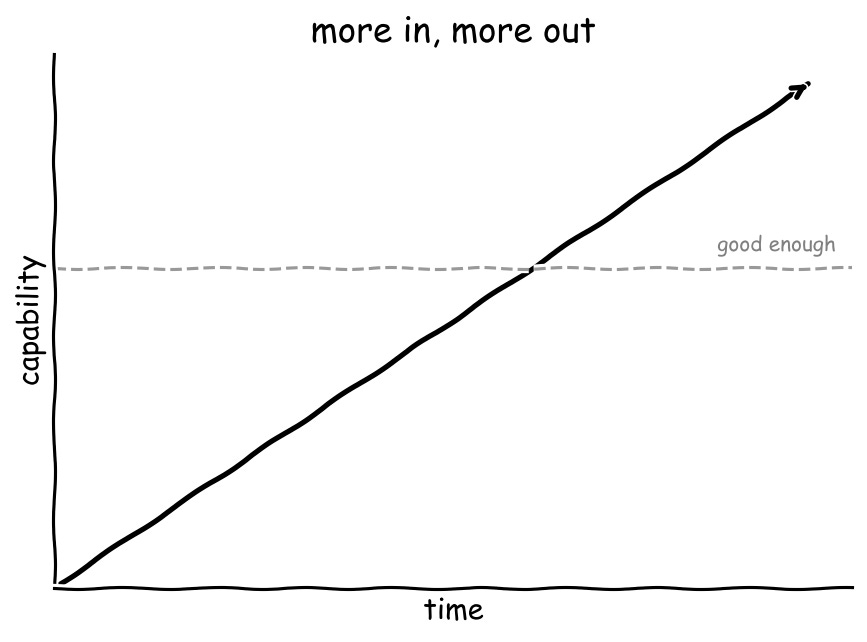
More in, more out. It’s how budgets work, how quarterly plans work, how promises get made. Jordan Ellenberg, in How Not to Be Wrong, calls this false linearity — the unexamined assumption that the relationship between effort and outcome is a straight line. Raise tax rates, collect more revenue — until you raise them too far and collect less. Eat more, get stronger — until you don’t. The straight line is a useful fiction for small ranges. We just keep forgetting the range is small.
The skeptic walks away
Every so often a new technology shows up near the origin.
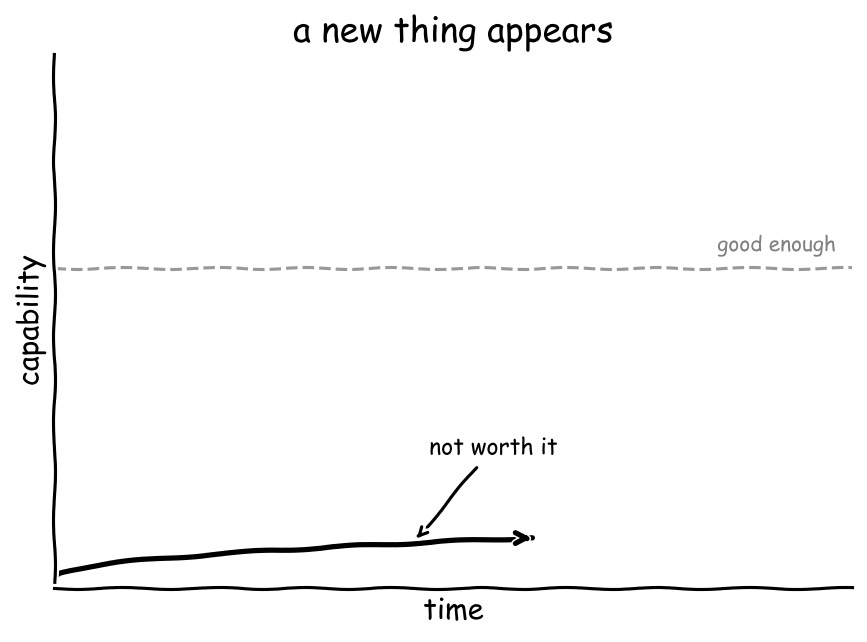
It can’t do much. It’s slower than what you already use, or clumsier, or uglier, or all three. A reasonable person looks at it and draws a line from where it is to where it’s going. The line stays flat. They walk away.
That projection is a linear projection — and it’s where the bug shows up first. The catalog is long: early cars losing to horses, early personal computers losing to typewriters, early language models unable to finish a sentence without contradicting themselves. Most of the people who walked away were right. Sometimes, rarely, they weren’t.
The curve bends
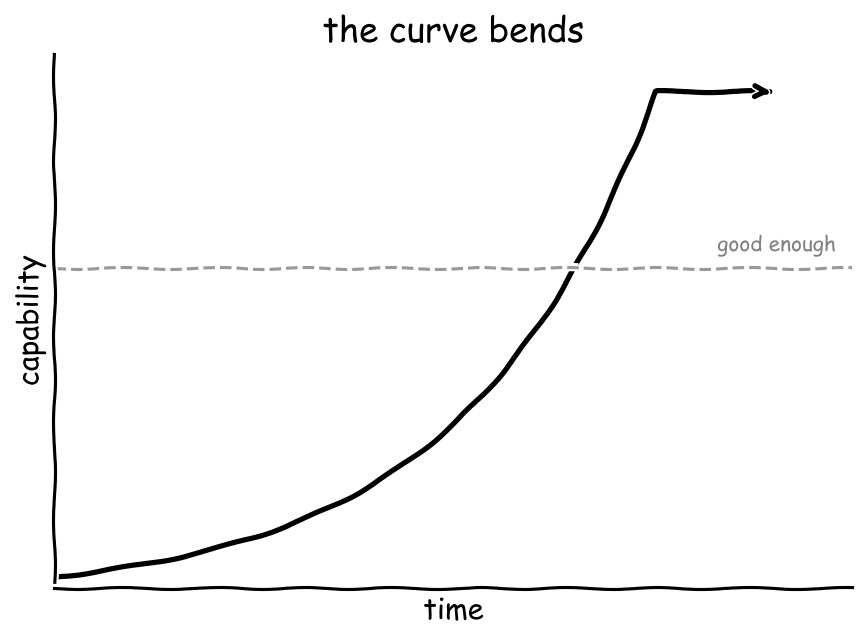
Tim Urban wrote about this shape a decade ago: from inside an exponential, you can’t feel it. The growth looks flat until suddenly it isn’t. The skeptics weren’t wrong about the data — they had the right data. They were wrong about the shape.
Every exponential is an S
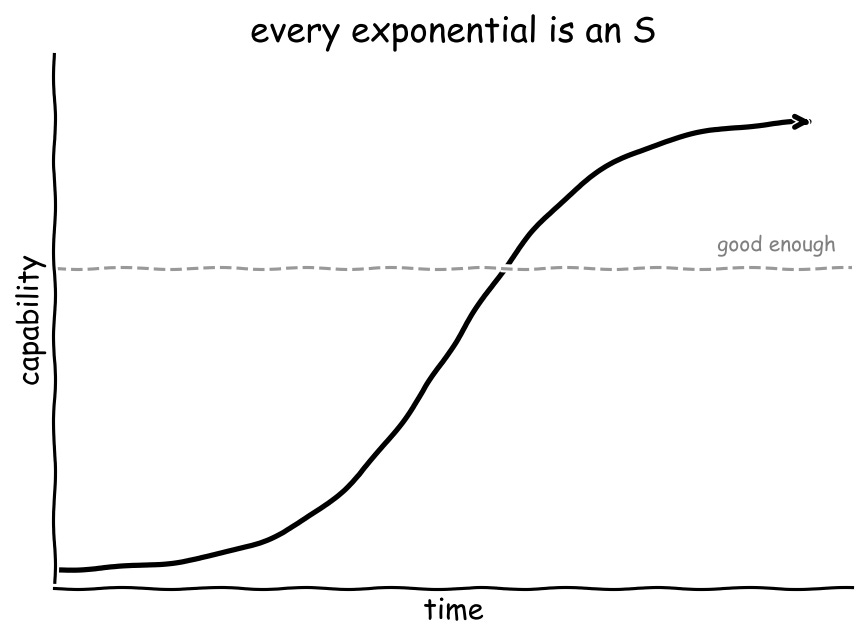
The same bug shows up on the way up.
People standing on the steep part of a curve draw a line from where they are to where it’s going. The line goes forever. So they promise forever. Anyone who has built a product has watched this happen twice — once when nobody believed in the thing, and again when everybody did. The curve was never a line at the bottom, and it isn’t a line at the top. Every curve finds its ceiling — engines against thermodynamics, crop yields against soil, Moore’s Law against physics itself. And in the current moment, insiders like Sara Hooker and Ilya Sutskever have been quietly pointing out that doubling compute now buys a couple of percentage points, not a new tier.
Sitting in 2026, it is very easy to look at Claude, at the speed of the releases, at the capability gaps closing, and draw a line. The line goes up forever.
Stacked
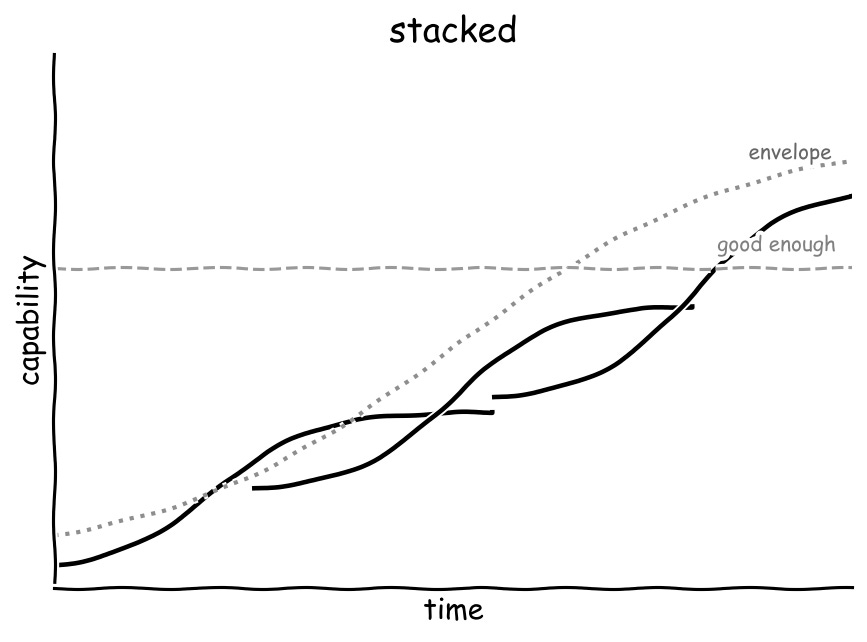
What actually happens, almost every time, is that the curve flattens and a new one starts rising underneath it. The dotted envelope running through their tops is what we mistake for a smooth exponential from a distance.
Progress is a stack of S-curves.
Ray Kurzweil plotted this for a century of computing — mechanical calculators, relays, vacuum tubes, transistors, integrated circuits — five S-curves whose envelope looks exponential only because each paradigm handed off to the next before running out. Horace Dediu has drawn the same shape for Apple: iPod to iPhone to iPad to Services, each product rolling over as the next one rose. Product managers spend entire careers riding curves and jumping to new ones. It isn’t a theory — it’s the job.
Right now
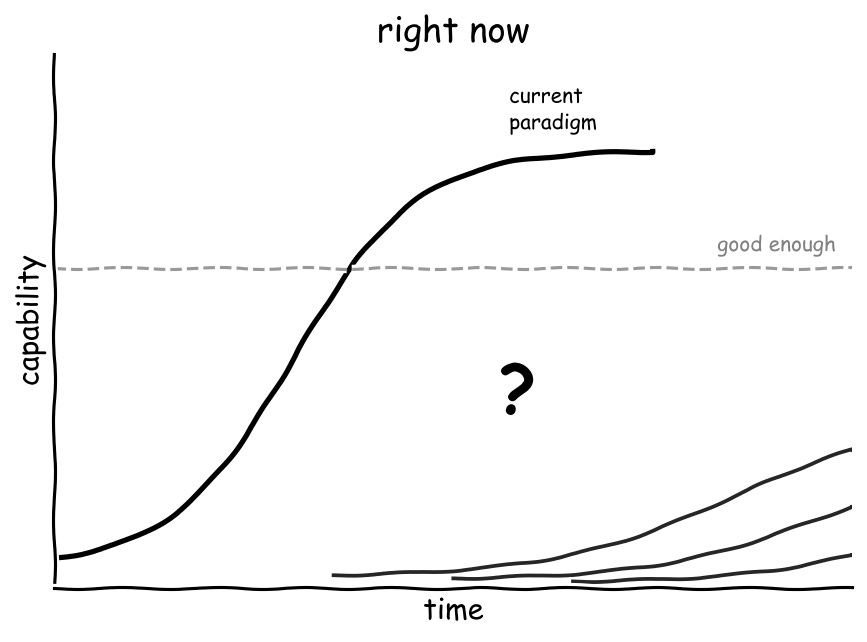
The transformer curve we’re on is mature, tall, and from the inside still feels like it’s going straight up. Underneath it, quieter, a handful of small curves are leaving the baseline — diffusion models for language, DeepMind’s world models, Yann LeCun’s JEPA, neurosymbolic hybrids. Most of them will go nowhere. One of them, probably, becomes the next tall curve. Nobody knows which.
The skeptic’s move here — “these small curves can’t do much, don’t bother” — is the same move as the believer’s move on the curve above: draw a line from where it is to where it’s going, and extrapolate. Both are linear projections, and both will miss the shape the same way. The curve at the top flattens, and one of the curves at the bottom bends. The bug doesn’t care which end of the picture you’re standing at.
When my daughter and I are biking and she’s grinding up a hill, I tell her don’t worry, what goes up must come down. It’s meant to get her to the top.
That isn’t the right line for this. The hill we’re on won’t come down — it’ll flatten. And the question isn’t whether the flattening is coming. It’s which of the smaller hills under our feet is the next one we’ll be climbing.