

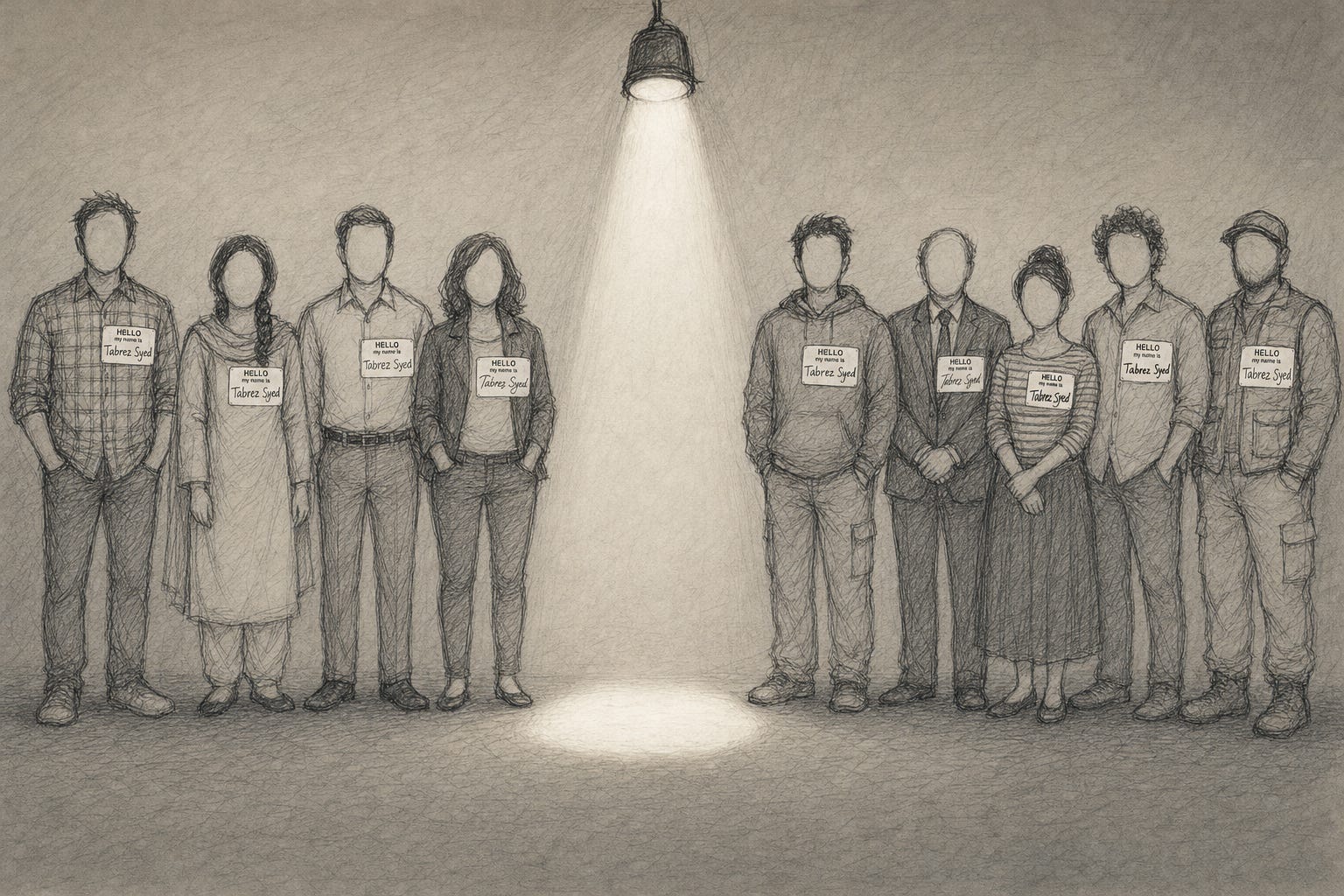
My daughter and I were goofing around with Google Home one evening, asking it about a local school. Somewhere between questions she leaned in and asked, “Who is Tabrez Syed?“ It gave a decent answer. I was a little stunned that it had anything to say about me at all.
So I got curious, the way you do when a speaker in your kitchen turns out to know who you are. I went to my laptop, opened Google’s AI mode, and asked the same question. Somewhere in the answers a Pakistani actor appeared, a man who shares my name and, as far as Google was concerned, a share of my identity. He showed up in regular search too.
I had no quarrel with the actor. But he was edging into my space, and I wanted to know why.
What it knows, and what it looks up
When you ask an AI about a person, it can answer from what it knows, the things baked into the model during training. Or it can look things up, searching the web as you ask and summarizing what it finds. For most of us, the first kind is close to empty. With search turned off, the best a frontier model could say about me was “possibly product management, startups or AI writing.” That’s a polite way of saying it had no idea. So everything Google Home told my daughter came from a lookup.
And the lookup finds a web full of Tabrez Syeds. There’s the actor, plus engineers, managers and executives scattered from Mumbai to San Jose, with nothing to tell us apart. The machine has to decide which pages describe the same person, and which of them to believe.
That’s an old problem, and we solved it long before search engines.
Who vouches for you
When we meet someone we don’t know, we don’t take their word for who they are. We go by who vouches for them. A friend recommends a contractor, or a former boss takes a reference call. When nobody we know can vouch, we fall back on reputation: the degree on the wall, the firm on the business card.
Search was built on this idea. In 1998, two Stanford graduate students, Sergey Brin and Larry Page, published the paper that became Google. They borrowed from the way scientists judge each other’s work, where a paper earns its reputation from the papers that cite it, and more so when those papers are well cited themselves. Brin and Page treated a link as a citation, so a web page was worth what the pages pointing at it were worth.
The AI that sits on top of search inherits the same instinct. The actor ranked because IMDb vouches for him, and IMDb doesn’t list just anyone. You need a produced film or show to get in, so a machine reading the web treats his page as a reference from someone with standards.
Two problems
So who was vouching for me? Mostly LinkedIn, and LinkedIn vouched for a résumé. Lead-generation sites, the kind that sell contact details to salespeople, had copied it outward, and Crunchbase listed the companies I’d started. The machine saw many sources telling one story, a job history, but most of them traced back to a single page I had written about my jobs: lots of sources, one witness.
The second problem was what had gone missing. I spent eleven years at Spiceworks, and my profile in its community chronicled all of it, thousands of posts and conversations. A few years ago it was one of the first things that came up when you searched my name. Then it went quiet. Spiceworks stopped letting Google index its profile pages, and eleven years of work lost the page that said it was mine.
People who believe in owning your corner of the web have been warning about this for a long time. Their answer has a name, POSSE: publish on your own site, syndicate elsewhere. When you hand your presence to a third party, the third party can change the rules, and your record goes with them.
So, own your home. The catch is that a page about me, on a site I run, is the one witness nobody has reason to believe. Is it even me who put it up?
This summer I decided to run an experiment and see how much of what Google and AI say about me I could change.
Pointing home
I started with the home. I took a domain I had lying around and put up one page about me, listing every profile I had. Two weeks later the actor had dropped off the first page of results. My page was there too, at number eight, under six profiles still telling the résumé story.
So I went to the witnesses, and it turned out I had more than I remembered. LinkedIn and GitHub, DEV, a Medium account from years ago, Mastodon, Bluesky. I went back to each one, updated it, and pointed it at the new page, and the page pointed back at all of them. Every essay I publish now names that page as its author, too. When the witnesses point to one page and that page points back, the links start to look like a signature.
By early fall my page sat near the top of the results, and the copied résumés had started to fall away. But anyone can open a DEV or a Medium account, so those sites will vouch for just about anybody, while IMDb only vouches for people who’ve made a film or a show. I had plenty of witnesses and none that were picky, so I went looking for ones with at least some bar to entry.
Witnesses with standing
The first one I tried was podcasts. To get listed on Apple Podcasts or Spotify, you have to actually produce a podcast. It’s a low bar, but it’s a bar, and I cleared it the easy way: I had an AI voice narrate my essays and submitted them as a show on both. To my surprise, Apple’s listing shows up on the first page of Google for my name. Spotify’s doesn’t, though it’s the same show with the same episodes. For whatever reason, Google takes Apple’s word for me and not Spotify’s. So a machine reading my essays aloud earned me a reference from Apple, which the other machines respect.
Then there’s Google Scholar, which vouches for people who’ve published research. I’m not an academic, but it turns out I had published, just a very long time ago. Back when I was an undergrad, I co-wrote a paper with my advisor on security managers in Java and presented it at a conference, but it never made its way online. So I dug it up and put it online. While I was at it, I added a patent from my Spiceworks years that I hadn’t thought about in a decade. I made a Scholar profile, attached both, and pointed it home. Google learned to rank the web by borrowing from academic citations, and here I was, going back to the citations.
An old undergrad paper and a forgotten patent don’t say much about who I am today. But somebody checked each of them before letting it in, which is more than anyone did for my Medium profile.
The reference check
Here’s what Google’s AI mode says when I ask it now.
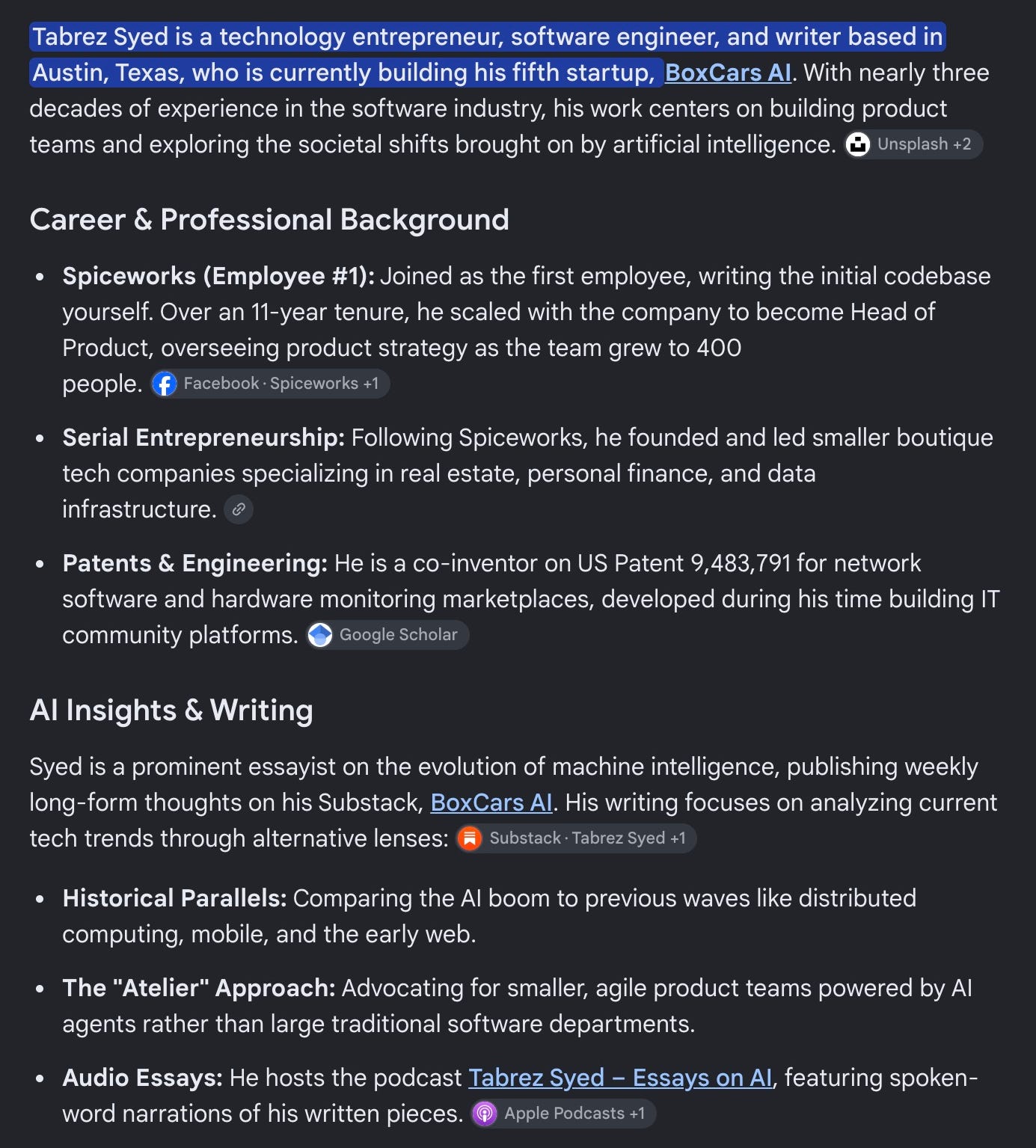
Read it the way you’d read a reference check. The opening line, a technology entrepreneur and writer in Austin building his fifth startup, is sourced to Unsplash, of all places. Of every witness I pointed home, a photo-sharing site is the one it leads with. Scholar gets named for the patent, Facebook covers my eleven years as Spiceworks’ first employee, and Substack and Apple Podcasts vouch for the writing.
It also calls me “a prominent essayist,” which is generous. I only went out to see what could be done. This summer the machine couldn’t tell me from an actor, and now it’s writing my blurb.
Uh-oh
Then I scrolled back to the top and looked at the pictures.
There are four of them, and none of them are me. A street sign, and three men who presumably share my name. My words have witnesses now. My face has none, so the machine filled the gap with whoever it could find.
Looks like I have more work to do. I’m just not sure what vouches for a face.
P.S. This essay is now a witness too. It’s on Substack, it names me as the author, and it points home. If Google decides Substack is picky enough, it just helped.