


Last week (November 13, 2026), a router installed during a copper-to-fiber upgrade started flooding the FAA’s network, and the FAA ordered a nationwide ground stop. The planes were fine, and so were the controllers. What choked was the layer that let people coordinate the planes.
It struck me because I live with a smaller version of that now. The left panel of my Claude Code window is jammed with agents, each with a little orange dot that means it’s waiting for an answer from me. Some of them are running sub-agents of their own, farming work out to sessions I never opened. Most days I set the goals and they get on with it. Other days the dots pile up faster than I can read them, and I end up calling a ground stop of my own, more often than I’d like to admit.
Then and now
I didn’t start here. I remember when a single chat with an AI was mind-blowing. I’d ask it for a few lines of code or one function and marvel at how much got done. Now a single agent lands thousands of lines at a time, and I have about fifteen of them going.
Flying went through the same two kinds of growth. The Ford Trimotor, one of the first real American airliners, carried about a dozen passengers when it came out in 1926. Today a single jet flies hundreds of people at once, and the FAA handles more than 44,000 flights on an average day.
Out of their heads
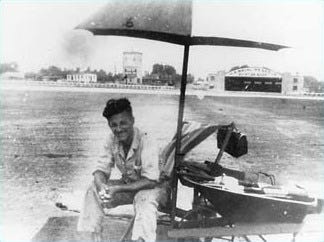
I went looking for how air traffic control handled its own version of this, and the story starts with almost nothing. In 1929, at the St. Louis airport, a man named Archie League directed planes with a wheelbarrow and two flags. He could see every plane he managed, so a flag was all the tool he needed.
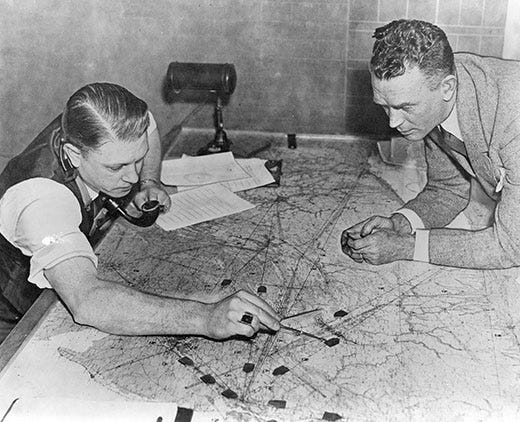
By 1935 there were more planes than one person could see, let alone hold in their head. At Newark, controllers were tracking flights in cloud with no radar at all, working from radio reports and a table map. Each plane became a small brass marker, later nicknamed a shrimp boat, that they moved across the map by estimate. Clipped to each marker was a strip of paper with the flight’s ID, departure time and altitude.
People call tools like these tools for thought. Andy Matuschak and Michael Nielsen, who have spent years thinking about them, write that good tools for thought arise mostly as a byproduct of doing original work on serious problems. My shorthand is that tools have to earn their place, and the strip did the day there were more planes than anyone could see.
My own strips
My tools came the same way, one break at a time. At first the chat sessions held the work, until I lost track of which conversations I needed to have, so I started a tickets.md file to tell me. That grew into a backlog.md, which was fine until I needed to see across several repos at once and moved everything to GitHub issues. Once a single feature meant too many tickets to follow, I grouped them into epics, and then built a skill that slices each epic into small pieces that ship fully working.
Four minutes
Now the work comes in dozens of epics, and hundreds aren’t out of reach. Teams have always juggled lots of tickets and a fair number of epics. Nobody has had to keep hundreds of epics pointed somewhere at once, and that’s where my tools run out, the way Archie League’s flags did when the planes multiplied. I’ve gone from writing the code to being responsible for the agents that come flying in with their answers.
I review differently now too. I used to read pull requests in GitHub, line by line. Now Hermes, an agent I run on a server outside that panel, talks to me in Slack, like a colleague. It sends a short summary and a link to whatever it made, a prototype to click through or a draft to read, and I reply with comments. That’s closer to a strip than the whole flight. Even so, more keeps coming, and I know a simpler approval gets closer to a rubber-stamp without understanding.
Pilots have the same split. One study of about 14,000 short-haul flights found that on most of them, the pilots flew the plane by hand for about four minutes. Those minutes come at the two ends. The crew takes off by hand, the autopilot handles the climb, cruise and descent, and the crew takes over again for the last few minutes before touchdown. Mine come at the same two ends, deciding what to build and deciding whether what comes back is ready to land.
Flight plans
Planes have one advantage over my agents. Every one of them is going from one place to another, and everyone knows where. Before a plane moves, the pilot files a flight plan, and the strip a controller works from is printed from it.
Once you know where everything is headed, you can build automation on top of it. In September 2026, the FAA launched a tool called SMART, short for Strategic Management of Airspace, Routes and Trajectories. It reads flight paths, weather and traffic to spot congestion before it develops, and on November 10 the FAA said it was expanding SMART to all 22 regional centers. Its recommendations go out to the facilities, where local management decides whether to act on them, and controllers still keep the planes apart. Further out, under a framework the FAA calls trajectory-based operations, it wants to work out each flight’s path gate to gate before it leaves, down to when it should arrive.
I think software is ready for its own version of the flight plan. Tickets and epics track the work, but they don’t say where it’s all going, so I’ve started building skills for that layer. The first is /pitch, which asks what a piece of work is for, and what solved would look like, before anything gets built. It’s brand new, and it hasn’t earned its place yet.
What’s changed is volume. When building was the bottleneck, a company could get by with one flight plan a year. I’ve sat in the off-site where it got made, with leadership and every product manager in the room, people pitching and arguing about impact until we committed to what we’d build. Now that building isn’t the bottleneck, the flight plans multiply. You could build everything, but you shouldn’t.
When I look at the left panel now, the orange dots look like planes held at the gate, each one ready to go and waiting on one of my four minutes. Are they all going to the right places?