


Why does Luke Skywalker bring R2-D2?
You remember Star Wars, right? The final scene where the rebellion sends fighter pilots to attack the Death Star. Every X-wing has onboard systems. The ship can fly itself well enough. But Luke and the other pilots bring their own droids. Why?
Luke doesn’t want a generic autopilot — he wants his droid, the one that knows how he flies, what he’s been through, what he’s likely to do next. R2-D2 doesn’t come with the plane. R2-D2 comes with Luke. Ship to ship, mission to mission, the relationship travels.
Last week I wrote about a version of this arriving on the web — WebMCP, a new browser standard that lets you bring your own AI agent into any website. Your copilot in someone else’s cockpit.
But plugging in is one thing. Working together inside is another. If R2 silently reroutes power and Luke doesn’t notice until the shields drop, that’s not collaboration — that’s a surprise. If Luke has to keep asking what R2 just did, they’re not flying together — they’re having a conversation about flying, which is slower and worse. The droid and the pilot need a shared way of working — an interface where every action is visible and every move makes sense to both.
That’s exactly where the web is now. WebMCP solves the plugging-in problem. Nobody has designed the cockpit for two yet.
Your Droid, My Cockpit
Consider a real estate site. Today, if the site is ambitious, it offers a chat assistant — the built-in autopilot. You can type “show me three-bedroom homes under $600k” and it filters the listings. Helpful enough. But the chat assistant is a stranger. So you end up explaining yourself from scratch: where you work, how long a commute you’ll tolerate, that your daughter likes her school and doesn’t want to switch. Talking to an AI bot on a website today is marginally better than interacting with the filters directly. Perhaps.
Now imagine arriving with your own agent — the one you’ve been mulling over buying a new house with for weeks, running financial comparisons, weighing pros and cons. You’re ready to look at actual listings, but rather than having the agent wait outside while you shop, you bring it into the site with you. The way you might take a personal stylist shopping at Neiman Marcus. (I haven’t, but I’m assuming that’s what you do.)
You say “show me some houses I might like” and your agent plugs into the site’s tools through WebMCP. It knows where your daughter goes to school and how much you hate your cross-town commute. It can look at each listing and calculate school drop-off times. It can scan photos and notice whether the yard is fenced for your dogs, or whether the guest room layout would work for when your mother-in-law visits, or whether there’s space in the back for your smoker. You don’t want a filter for “good schools.” You want homes within 15 minutes of Ridgetop Elementary. You never have to spell these things out on the site, because you’ve been spelling them out in conversation for weeks.
This is why someone brings R2-D2 instead of using the autopilot. Not because the autopilot can’t fly — but because R2 already knows the mission.
But websites were designed and built as single-player experiences. They break when you bring a second player. Your agent filters the listings, the page updates — results reorder, cards disappear, new ones surface at the top — and you’re not sure what just happened. So you open the chat panel and ask. The agent explains: filtered out properties with school ratings below 7, removed two that would put your commute over 40 minutes. Useful — but now you’re reading a paragraph in a chat window about changes that already happened on a page you’re still trying to parse.
Imagine if Luke had to stop flying and ask R2 to explain every change. He’d never have made it down the trench. What makes the X-wing cockpit work is that both pilot and droid can see the same instruments — shared gauges, shared readouts. The interface is the collaboration.
The Board Is Truth
I’ve been thinking about this a lot. What would it actually mean to redesign a website around the expectation that visitors bring their own agents?
I kept coming back to board games. Sit down at any board game and two or more players share a single surface. Someone takes a turn — buys a property, moves a piece, plays a card — and the board changes in front of everyone. You never have to ask “what did you just do?” You look at the board. It shows you. Conversation happens around the board — players negotiate, strategize, question each other’s moves — but the board is what’s real. Chat is commentary; the surface is truth.
The other analogy that stuck was the personal stylist. When you walk into a high-end store with your own stylist, the store doesn’t send a commissioned sales associate to compete with them. Instead, it provides the dressing room, the mirrors, the merchandise to work with. And because you’re shopping in their store, they can observe what catches your eye and help your stylist find more of it. The store becomes a collaboration surface — not between you and the store’s employee, but between you and the person you already trust.
A website for two works the same way. The site’s job isn’t to provide its own agent. It’s to provide the surface — the board — where you and your agent can work together. And because you’re on their site, they can make your agent’s job easier: exposing rich data, providing tools for comparison, letting the agent rearrange and annotate what’s on the surface.
To explore this idea, I built a demo to explore what this might look like. A real estate site, designed from the ground up as a website for two.
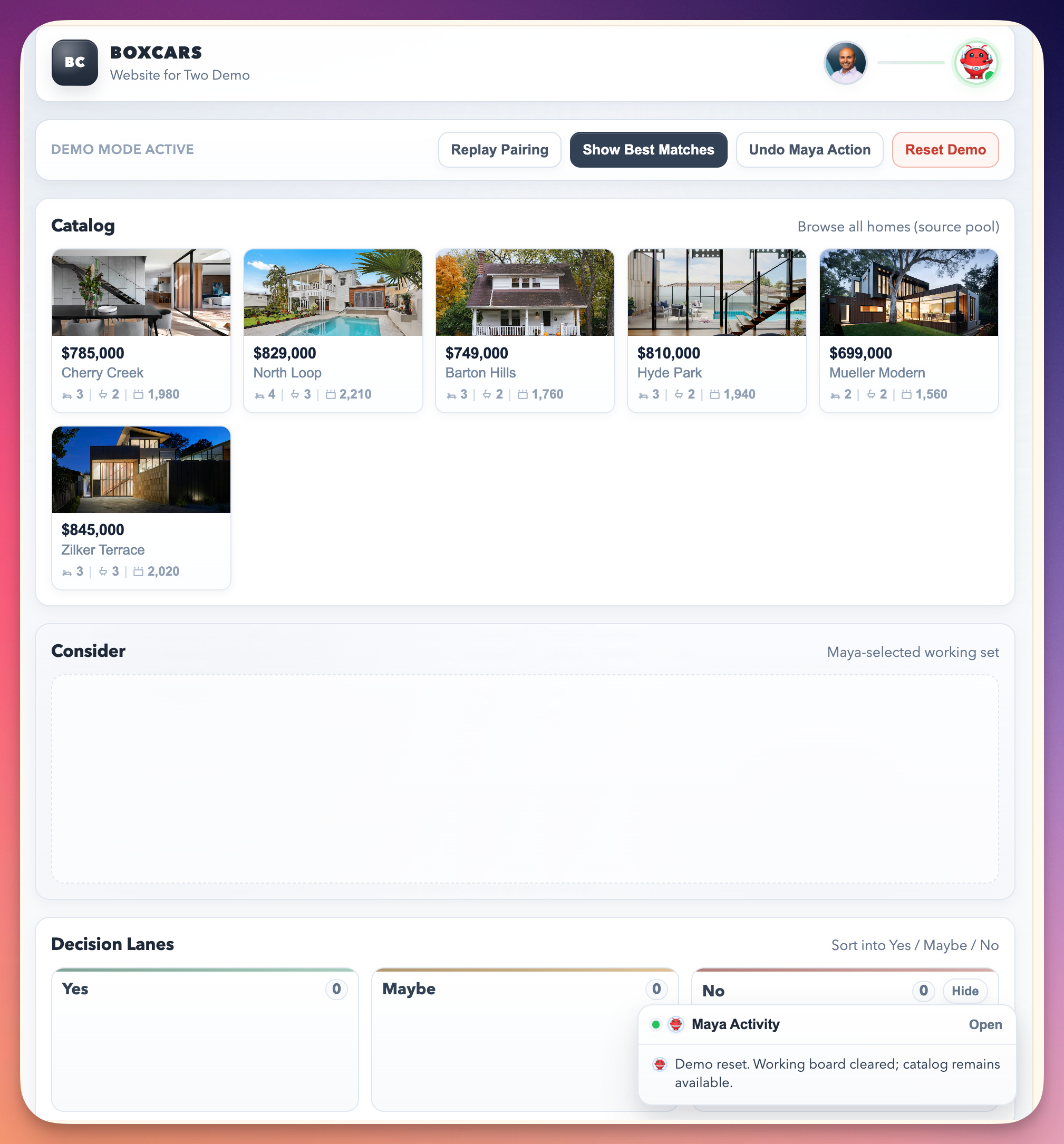
When you arrive, the page isn’t a list of search results with filters down the side — it’s a shared board. A catalog of available homes runs across the top, the full inventory. Below it, a working set that your agent, “Maya”, is curating for you. Her avatar sits next to yours in the top bar — not hidden in a chat sidebar, but at the table.
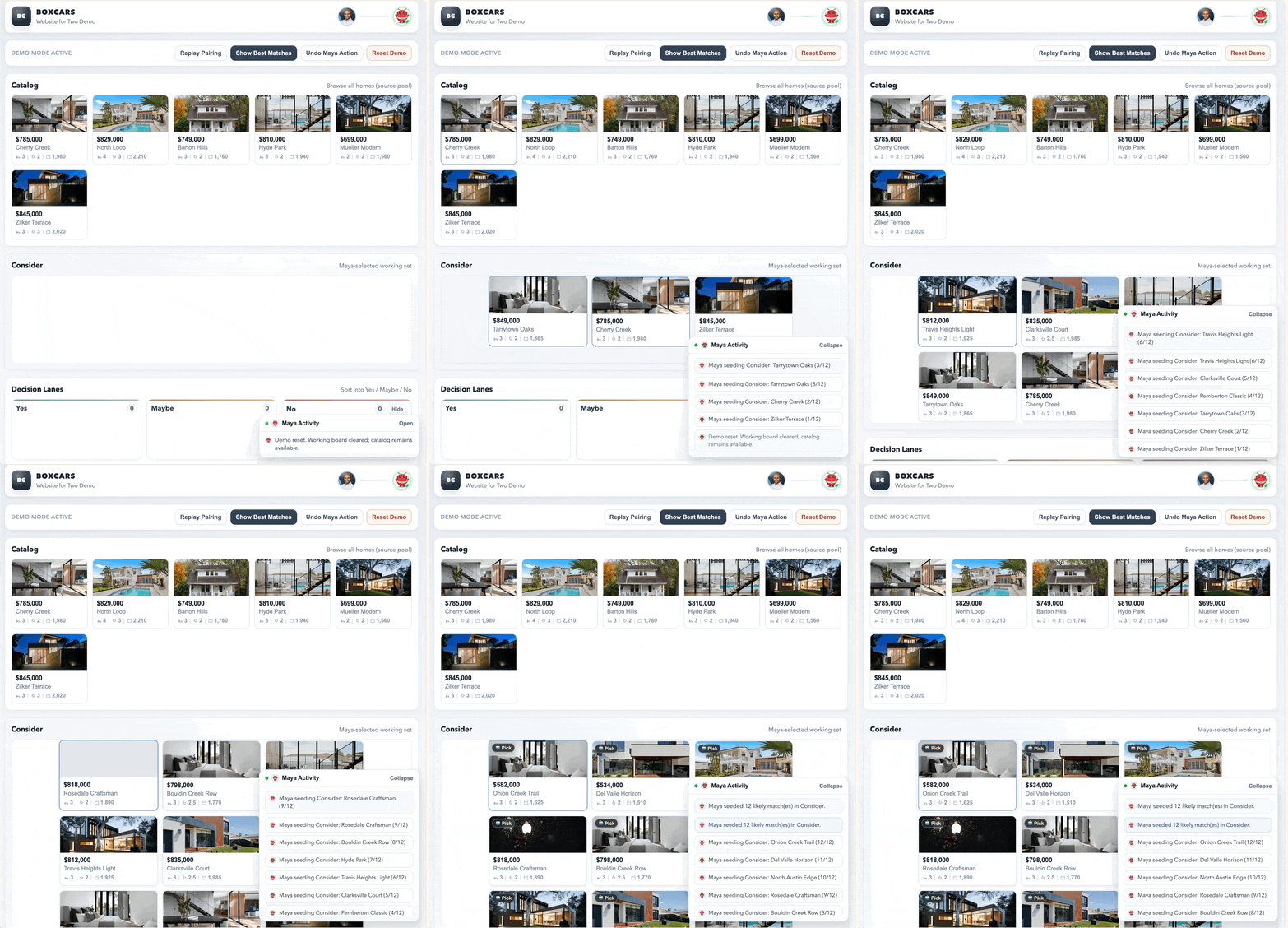
You tell Maya to show you homes you might like, and she goes to work on the board. She pulls listings from the catalog into the “Consider” lane — each one tagged with a “🤖” badge so you can see which cards she chose.
Click into a listing and this is where it gets personal. The site shows the standard details — price, beds, baths, square footage — but below that, Maya has added a section: “How This Fits Your Week.” School drop-off stays around 10 minutes from this address, and your regular Central Market run stacks easily into weekday errands. She’s also flagged a concern: the noise level because of how close the lot is to a restaurant.
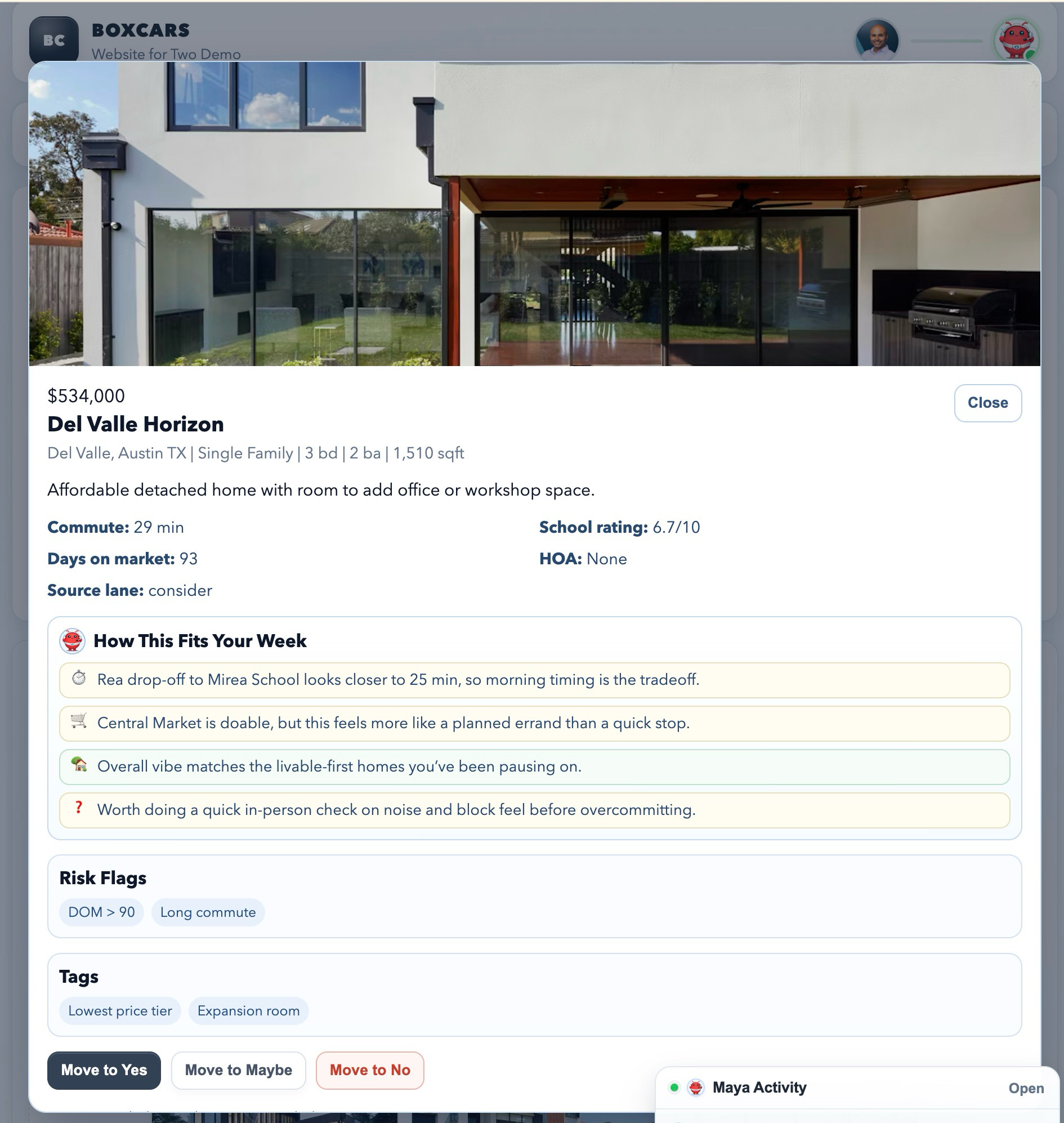
No real estate site would ever show you this. These aren’t filters a product manager designed. This is your agent annotating listings with your life — your school, your grocery store, your weekend rhythm.
And here’s what the site doesn’t know: why Maya chose those listings. She searched for homes within a 15-minute drive of a specific address — but the site only saw the address and the radius, not the fact that your daughter goes to school there. The personal reasoning stays with your agent. The site provides the tools; your agent provides the strategy. The board doesn’t need to know why you’re making your moves.
And if you disagree with something Maya did — if she moved a listing you wanted to keep — just drag and move the card back into consideration. Maya can see your actions, as can the site. The board is shared; the control is yours.
A Three-Player Game
For thirty years, the web has been a two-player game. The site holds the intelligence — the data, the inventory, the recommendations. The user brings the context — search terms, clicks, form fields. That exchange is the whole interaction model.
But people are starting to invest in their own agents — training them with preferences, constraints, the texture of their daily lives. That makes the web a three-player game. And the current industry trajectory — making a site’s own AI smarter — may not be the right response. That intelligence is a stranger to the user. The user’s agent is not. The smarter the site makes its own AI, the more it risks becoming the commissioned sales associate who steps in front of the personal stylist.
The opportunity might be different: build the board, not the brain. A real estate site doesn’t make money when someone searches — it makes money when someone books a showing with a realtor. If the visitor’s agent helps them find the right homes faster, with higher confidence, they book viewings sooner and with stronger intent. The site wins the same way Neiman Marcus wins when a customer’s stylist picks out three perfect outfits: they’re still buying merchandise, and buying more of it because the match was better.
The more useful the board, the better the visitor’s agent can do its job — and the more reason people have to come to the site in the first place. Because if they can’t bring their agent to a site and work together effectively, they’ll find one where they can.
Luke Skywalker didn’t need the smartest X-wing. He needed one that flew well and let him and R2-D2 work together seamlessly. That might not be a bad blueprint for what comes next.